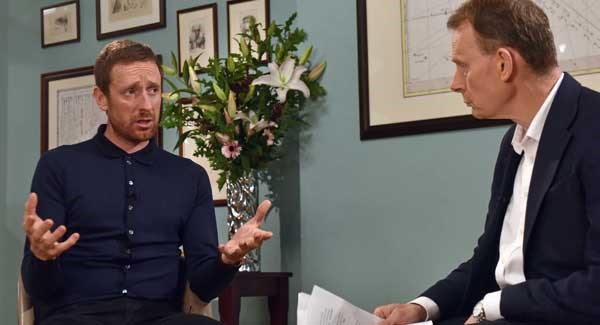
Bradley Wiggins and broadcaster Andrew Marr came up with a piece of television that will do nothing to address the doubts people have about whether the TUE system was being abused.
Having decided to speak to heavyweight broadcaster Andrew Marr on his BBC TV show this morning to try and defend himself against allegations of abusing the TUE system, Bradley Wiggins appears to have said little that will ease the pressure.
He was not helped in his bid to clear his name by an interview style and questions that were not robust enough.
Wiggins told Marr he took corticosteroid triamcinolone under TUEs before the Tours de France in 2011 and 2012 and before the Giro in 2013 to address a medical condition rather than gain any unfair advantage.
He said he struggled with breathing problems related to asthma and a pollen allergy and that injections of the drug were an effort to neutralise the issue so he could go on and compete at the highest level.
Advertisement
“It was prescribed for allergies and respiratory problems,” he said.
“I’ve been a lifelong sufferer of asthma and I went to my team doctor at the time and we went in turn to a specialist to see if there’s anything else we could do to cure these problems,” said Wiggins.
“And he in turn said: ‘Yeah, there’s something you can do but you’re going to need authorisation from cycling’s governing body'.
“This was to cure a medical condition. This wasn’t about trying to find a way to gain an unfair advantage, this was about putting myself back on a level playing field in order to compete at the highest level.”
Sir Bradley Wiggins insists he had no "unfair advantage" from drug https://t.co/cCN7veDQDx #Marr https://t.co/7L9yxEoFOX
— BBC News (UK) (@BBCNews) September 25, 2016
In effort to justify taking a power drug - which is used for serious asthma attacks – in 2012 just weeks after winning the Criterium du Dauphine and days before the Tour, he said:
"June-July is the worst period for that - April, June, July, right through those months - and I was having problems.
Related News


"When you win the race three weeks out from the Tour de France, as I did, you're the favourite for the Tour.
"You have the medical team and coaches checking everything's OK - 'Bradley, you're on track here, you're the favourite to win this race, now we need to make sure the next three weeks is... is there anything we can help with at the moment?'
"'Well, I'm still struggling with this breathing, I know it didn't look like it but is there anything else you can do just to make sure that I don't, this doesn't become an issue into a three-week race at the height of the season?'
"And, in turn, I took that medical advice (to take triamcinolone)."
Wiggins also tried to address the apparent inconsistencies in his 2012 book My Time in which he said needles were not part of the culture of British Cycling and the only time he had had them was for vaccines and dehydration drips.
In a muddled explanation to Marr, he said when he addressed the issue of needles in the book was speaking about needles for doping, as the debate in cycling at the time was very much about that issue.
“I wasn’t writing the book, I was writing it with a cycling journalist who’s very knowledgeable on the sport and had lived through the whole era of the Lance Armstrong era and the doping era,” he said.
"It was always a loaded question with regards to doping. Intravenous injections of iron, EPO etc, no one ever asked the question: ‘Have you ever had an injection by a medical professional to treat or cure a medical condition?’
"There are two sides to that, and at that period of time it was very much with a doping emphasis in the question.
“All the questions at that time were very much loaded towards doping,” said Wiggins.
He insisted Team Sky had always followed the rules but suggested when any team in sport led the way like Team Sky in cycling questions would always be asked, especially in a sport such a cycling when drugs had been a major issue.
“Cycling has been through a very turbulent period the last couple of years in the post Lance Armstrong era, and obviously I won the Tour De France right at the height of that in 2012...
"And it’s still an open wound in cycling and it will take many years to get over that. Especially for the guys that are winning and competing at performing at the Tour de France.
“Whoever is leading in the sport at that time, and at the moment it’s Team Sky, they’re leading the way, and you know, they’re setting the standard for everybody. And they’re the best at what they do.
"Unfortunately when you’re the best of what you do sometimes comes scrutiny. Especially in a sport that has a tainted history.”
Topics


