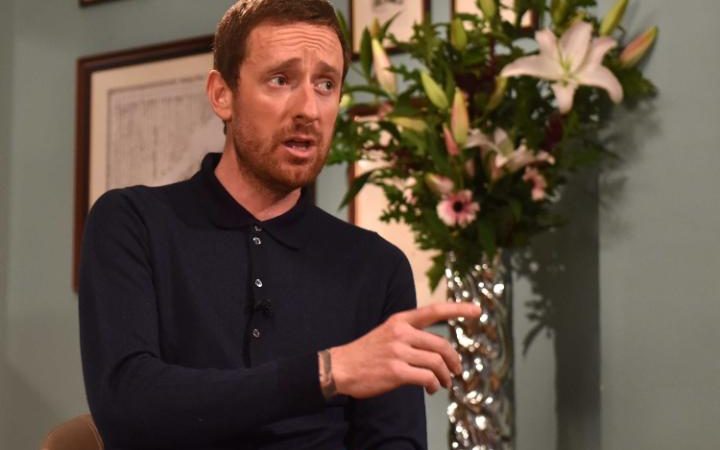
Don't worry if you missed Andrew Marr's interview with Bradley Wiggins on BBC TV; we have the full video below and the transcript.
- Wiggins reputation on brink of ruin, but Team Sky asked for this
- Wiggins denies cheating in weak BBC interview appearance
The video of the interview
Transcript of Wiggins speaking to Marr
Andrew Marr: Now, you have been the absolute poster boy and hero of this whole movement. But your reputation has been under some attack after a leak of medical records which suggest that you took a certain drug before some races. Can you explain what drug you took and why?
Bradley Wiggins: Yes, I mean, you know, cycling has obviously been through a very turbulent period the last couple of years in the post Lawrence Armstrong era, and obviously I won the Tour De France right at the height of that in 2012, and – and it’s still an open wound in cycling and it will take many years to get over that. Especially for the guys that are winning and competing at performing at the Tour De France. But this, you know, I’ve – I’ve – I’ve been very clear in the past and have been very transparent to the governing bodies that legislate our sport, the World Anti-Doping Agency, the UCI, the Unicyclist International, and I’ve been a particularly – I’ve been put in a position this week where I have to come out and explain. I’m just glad that I’m here now and I’m able to have my say and clarify a few points.
Advertisement
Andrew Marr: So you took a drug called triamcinolone, and that is for allergies and other muscle problems.
Bradley Wiggins: It was prescribed for allergies and respiratory problems. I’ve been a – a lifelong sufferer of asthma, and I – I went to my team doctor at the time and we went – in turn went to a specialist to see if there’s anything else we could do to cure these problems. And he in turn said, ‘yeah, there’s something you can do but you’re going to need authorisation from your cycling’s governing body.
Andrew Marr: You needed permission..
Bradley Wiggins: You have to prevent, you have to show and provide evidence from a specialist that – that they will then scrutinise with three independent doctors and authorise you to take this product. So if one of those three doctors says no, you don’t – you get declined.
So I think that’s a very important point, that actually as an athlete you go to your doctor, like in most sports teams, and you say, ‘I have these problems, is there anything we can do about it? Is there anything else I can take that I’m not currently taking?’ You go to a specialist, you sit in the room of that specialist, he studies you, comes to a diagnosis, you then apply for as TUE, a therapeutic use exemption, and that goes to the governing body. They in turn, three independent doctors, scrutinise the evidence, the information, in turn agree or disagree, and that comes back, and at that point then, once I have a certificate from the World Anti-Doping Agency and the sport’s governing body, only then do you take the medication.
Andrew Marr: Now, the trouble with this particular drug is that lots of people say it is also a performance enhancer. There was – was a German cyclist Jorg Jaksche, who says that – after he’d taken it he said, ‘you’re going to suffer less, you’re going to be less tired as your recuperation is faster because of the anti-inflammatory effects, and you know, other people have said the same kind of thing. David Millar said it was the most potent drug that he’s ever taken.
Bradley Wiggins: Yeah, but I think there’s – they – they were abusing that drug in that era. This –
Andrew Marr: So they were simply taking more of it?
Bradley Wiggins: More of it, and abusing it, and – and this was to cure a medical condition. And was – was – the governing body, the World Anti-Doping Agency, everyone said this guy is not – this was about not – this wasn’t about trying to find a way to gain an unfair advantage, this was about putting myself back on a level playing field in order to compete at the highest level.
Andrew Marr: Now, you used it three times. The first couple of times, from your medical records, you were clearly unwell. But the third time, before that 2012 Tour de France you were doing incredibly well. In fact, you – you were caning them all of the – the early stages, you were the favourite to win, there seemed to be no medical problem, and yet you took it again.
Related News


Bradley Wiggins: Yeah, I – I really struggled in that period. June-July is – is the worst period for that. April, June, July, right- right through those months, and – and I was – I was having problems. And, you know, when you win the race three weeks out from the Tour de France, and I did on the Dauphiné Libere, you know, you’re the favourite for the Tour de France, the – the team, the Team Sky, you know, you have the medical team there, everyone – there’s coaches checking everything’s kind, Bradley you’re on track here, you’re – you’re the favourite to win this race, now we need to make sure the next three weeks is – is there anything we can help with at the moment? Well, I’m still struggling with this breathing last week. I know it didn’t look like it but I – I kind of really – is there anything else you can do just to make sure that I don’t – I don’t – this doesn’t become an issue into a three-week race at the height of the season? And – and in turn I take that medical advice. And –
Andrew Marr: We should emphasise then, nobody is suggesting that you have done anything illegal at all. But David Walsh, who was the journalist who exposed Lance Armstrong and was invited in for Team Sky for quite a few weeks to watch you all, has been involved with you, says that it’s not illegal but it looks bad. Do you understand why he says that?
Bradley Wiggins: I can understand the, you know, that’s still an open wound in our sport, and I’ve said, this particular drug was abused back in that era. But I think – I think as I said, even with the needle comments that I made, this – this was about, at that time if can paint a picture of the landscape at that time, in 2012, right at the height of Lance Armstrong and – and just before the crash, as it were, with him, that the landscape – have you ever use needles? It was – it was always a loaded question with regards to doping. Intravenous injections of iron, EPO etc, no one ever asked the question, have you ever had an injection by a medical professional to treat or cure a medical condition? There – there are two sides to that, and – and at that period of time it was very much with a doping emphasis in the question.
Andrew Marr: But you did say, ‘I haven’t been injected, I haven’t used needles, except for vaccinations.’ And that wasn’t quite true was it?
Bradley Wiggins: Well, for medical conditions, I think at the time that the book I was - I wasn’t writing the book, I was writing it with a cycling journalist who’s very knowledgeable on the sport and had lived through the whole era of the Lance Armstrong era and the doping era.
Andrew Marr: So from your point of view needles meant have you been doping, and the answer was no?
Bradley Wiggins: All the questions at that time were very much loaded to – towards doping.
Andrew Marr: Now, at the time that Team Sky was promoting its – its latest achievements, people were pointing to the – the the blue stripe –and somebody said that blue stripe represents the difference between doping and doing something illegal and we absolutely push up against the limits of what is allowed, we are really professional, we’re really tough, we do everything we can to win. But we never, ever cross that line. Do you accept that in this you’d have been absolutely against that? I’m saying you’ve crossed it, you’d have been nudging against it?
Bradley Wiggins: We have rules and legislations in our sport and we are governed by our cycling’s government body and by the World Anti-doping Agency. Now, those rules are there. As athletes we don’t invent those rules, we have to abide by the rules and Team Sky, especially team – biggest cycling team in the world, 100 per cent everything that they have done in this has been within the rules and abided by the rules that are set to us, and – and we are being scrutinised for abiding by the speed list, the same within the speed limit.
Andrew Marr: And of course Team Sky has had a very, very hard time from lots of other countries, the French and others have been borderline insinuating about your team because you have done so well. They ask are you superhumans, what’s going on? Is this the kind of insinuation you have to live with now?
Bradley Wiggins: Well, I think – I think that the – the sport lives with that, and whoever is leading in the sport at that time, and at the moment it’s Team Sky, they’re leading the way, and you know, they’re – they’re setting the standard for everybody. And they’re the best of what they do, and unfortunately when you’re the best of what you do sometimes comes scrutiny. Especially in a sport that has a tainted history.
Andrew Marr: Right, you are, apart fom being a great hero of the cycling world, you’re a kind of fashion icon, you’re very conservatively dressed today.
Bradley Wiggins: Thank you.
Andrew Marr: You’re interested in politics, you’ve written. What’s next for your?
Bradley Wiggins: Well, I’m just – at the moment I’m still actually training and competing, so that doesn’t finish till the end of the season in November. I’m just enjoying, post-Olympic, being at home, spending more time with the family, still love riding my bike, so I’m out on my bike most days. And I’m – I’m looking forward to all the opportunities that come my ways and there’s some in- there’s some interesting ones around. But at the moment just enjoying being at home for a bit.
Andrew Marr: Well, this is a political show and I’m interested in politics and so are you, and you said you’ve always been a Labour supporter, you invited Jeremy Corbyn to help when you were editing a programme and so on. I’m just wondering, there’s a guy, a team cyclist, could do with a bit of help. Are you interested in helping him in some way?
Bradley Wiggins: I don’t think he needs it, to be honest. I think politics at the moment – I follow it from afar, I’m a little bit disengaged with politics, although, you know, at the age I’m at now, 36, you – you tend to pay more interest, especially this year with the Brexit and everything, you have to – have to – you have to educate yourself. You have to be armed with knowledge when it comes to the issue, because it’s important for the country, for my own children growing up. And I’ve met Jeremy, lovely fella. Don’t – don’t agree with everything that he’s for, you know, I think the world is a – is a, you know, changing at a fast pace. But one thing I will say, you know, have – having been, my family, historically Labour, my wife Sally, all historically Labour, I think Theresa’s done a fantastic job in stabilising the country in the short term after the whole debacle in the summer.
Topics


