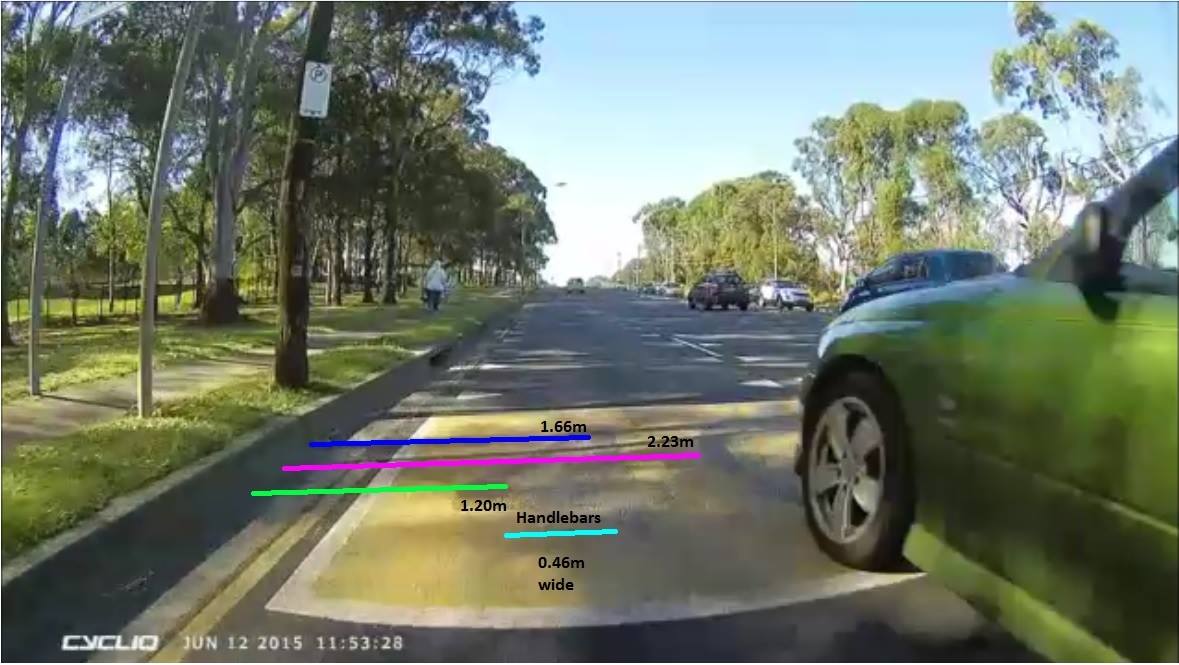
It may look like a few lines drawn onto a photo, but this evidence can be produced by any cyclist to prove their case.
It’s the one move on the roads that cyclists fear most and that happens to all us, probably on a regular basis; the close-pass.
Unless you have a bike-mounted camera or helmet-cam it will be very hard to prove that the close pass even happened.
And even with the footage, how do you prove the exact distance between you and the passing vehicle?
One rider who took the law, or at least the investigative work, into his own hands is Australian John Hawkins.
He got sick and tired of vehicles whizzing past him close as they wanted only to keep going and avoid prosecution.
So when he captured really good quality footage of one such close pass he set about putting a scale onto the footage to prove the car had broken the law.
Advertisement
He then took his evidence to the police. They accepted it and went to the driver who, when faced with undisputable facts, admitted what he had done.
His excuse was that he was 'having a bad day' on the day in question.

Once Hawkins measured the distance from the kerb to some of the markings on the road and could pinpoint where the centre of his bike was he could prove how close the vehicle passed him.
Related News


"When I replayed the video I realised it would be easy to pin this guy because the road markings took all the subjectivity out of the equation," Hawkins told stickybottle.
Using the distance of the road markings from the side of the road, he had a scale to apply to the rest of the clip.
This included how far the car had passed from the centre of the footage, which was also the centre of his handlebars.
"Police have far more work coming in than they can deal with, you need to make it as easy and clear as possible," Hawkins said of doing the analysis himself and presenting it to the police officer he was dealing.
Luckily the officer he was dealing with was "outstanding", according to Hawkins.
"If there is any subjectivity or room for doubt in distances I wouldn't submit it - it's a waste of their and my time."
Hawkins said the incident, in the clip below, occurred on June 12th of this year, saying the date on his camera at the time was exactly 12 months out of date.
He has just shared the footage now because the case has been concluded.
Unlike Australia, in Ireland there is no safe passing distance that motorists are legally obliged to allow cyclists.
But that does not mean you couldn't pursue a dangerous driving charge if you had footage.
You'd need to prove the precise distance the vehicle passed and find a garda who understood it was so close as to be dangerous.
The clip that was analysed with scale
Topics


