
The number of vehicles being clamped or removed because they are illegal parked on Dublin cycle lanes has plummeted and is now near zero, a Dublin City Council report reveals.
The number of times Dublin City Council’s parking enforcers took action against drivers parking in cycle lanes has plummeted by almost 80 per cent in the past two years.
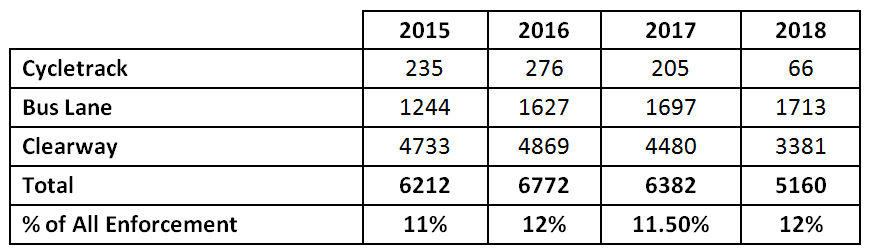
While enforcement has always been low, it plummeted last year to just 66 cases. That’s a fall off of 76 per cent on the 276 enforcements for parking on dedicated cycle lanes in 2016.
The figures have emerged in a report on “parking enforcement” released by Dublin City Council.
While the 66 enforcements last year relate to dedicated cycle lanes only, there were also enforcements for illegal parking on bus lanes and clearways, both of which can be used as cycle lanes.
Advertisement
However, even the level of enforcement for illegal parking on clearways and bus lanes is very poor.
Overall, the number of enforcements against illegal parking on cycle lanes, bus lanes or clearways combined reached 5,160 last year.
That’s down 20 per cent on 2017 and down 24 per cent on 2016.
Dublin City Council has said it gets more calls about illegal parking each year than it can act on.
Because of that, it must prioritise which cases to move against.
“Approximately 18,000 separate requests for enforcement are made per year,” it said in its parking enforcement report.
Related News


“These requests are prioritised for enforcement action depending on the nature of the complaint.”
The figures released today, see table below, very strongly suggest the council’s parking enforcers - Dublin Street Parking Services (DSPS) – have decided to almost completely turn away from illegal parking on dedicate cycle lanes and channel their resources into illegal parking on bus lanes.
Dublin City Council said that “in the region of 26 per cent of vehicles committing offences” are relocated or removed.
The council also clearly states leeway is given on many routes to drivers who only park illegally for a short period.
“In a significant number of cases parking (illegally) is a result of motorists making quick purchases in local shops and then returning to the vehicle, typically within a few minutes,” it says.
This presented “particular difficulties” for enforcement crews because at times drivers return to their vehicles before the enforcement is completed.
And in other cases a balance must be struck between the obstruction caused by brief illegal parking and the disruption that would be caused by clamping a car and so ensuring it stays in a location where it is causing an obstruction.
The balance must be struck because the illegally parked vehicle would be “moved within a couple of minutes when the motorist returns from the local shop”.
“Under normal circumstances enforcement crews will usually take a zero tolerance approach to enforcement of these offences on primary routes to and from the city,” it says, which clearly implies tolerance for short periods of illegal parking is extended on non primary routes.
Topics


