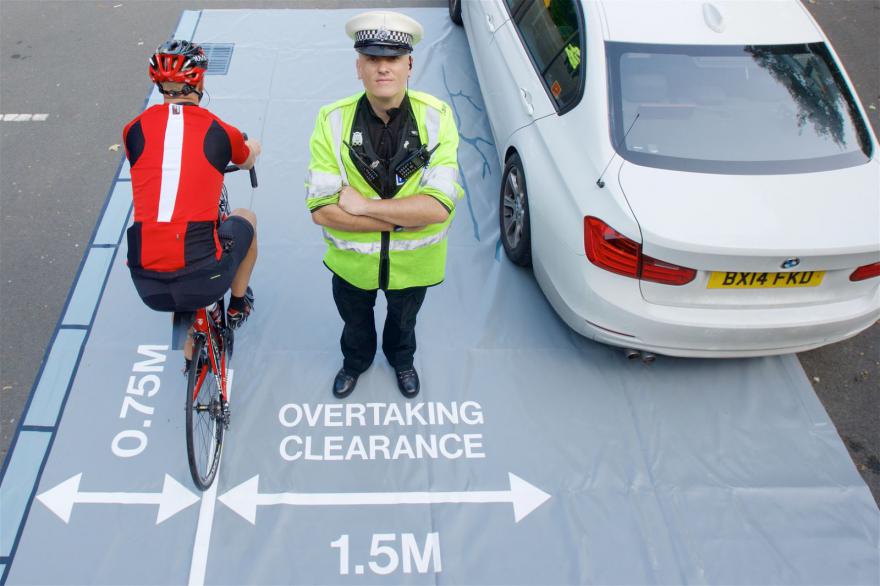
A Government promise to ban drivers overtaking cyclists too closely and make a specific offence of the practice has now been dismissed as impossible to introduce.
1.5 metre cyclist safe passing distance ruled unworkable
A Government promise to introduce a new specific offence for motorists who pass cyclists any closer than 1-1.5 metres will now not go ahead.
The mooted new law has been described as unworkable by the Attorney General, Seamus Woulfe SC.
He has advised the Government that there were constitutional rights issues, and practical issues related to the courts, that make the promised measures unworkable.
Because of that, the new minimum passing distance law will not go ahead. Instead, a general ‘dangerous overtaking of cyclists law’ will be created.
It would have no set distance at which cyclists must be overtaken. And it is not clear if a garda would need to witness the dangerous overtaking of a cyclist before a prosecution could take place.
Advertisement
In February, Minister for Transport Shane Ross promised the 1.5 metre passing distance would be enshrined into law and a new offence created.
The promise, which is now not being kept, would have made it an offence for motorists to pass cyclists any closer than 1 metre on roads with a speed limit of 50km per hour or less.
And on those roads were the speed limit was higher than 50km, the safe passing distance would have increased to 1.5 metres.
When Ross made the promise it was heralded as a progressive step forward and something that could bring about a cultural change among drivers in relation to cyclists.
And just last month Ross said he had been converted to cycling by those campaigners who had convinced him of the merits of the promised close pass legislation.
The main campaigner behind the push for the safe pass law has been Phil Skelton of the Stayin’ Alive at 1.5 group.
He has now issued an explainer statement about the latest developments. He has also released minutes from a meeting between campaigners and the Department of Transport on the issue.
The minutes confirm the stumbling blocks are “constitutional issues and practical court issues” though what those concerns are specifically is not set out.
Related News


And the minutes confirm the Department wants to press ahead with including the new ‘dangerous overtaking of cyclists’ offence under the fixed charge notice, or penalty points, system.
This could be introduced with months under the fines system. But also penalising drivers with penalty points would take approximately two years.
The delay arises because secondary legislation is needed for the penalty points and because of the changes required to the Garda IT systems.
As things now stand, the Department is awaiting advice from the Attorney General on the proposal to include the new ‘dangerous overtaking of cyclists’ offence to the penalty points system.
There will be concern about the new provision because it appears more subjective and less specific than the 1m-1.5m proposal.
Under the new proposal, if a Garda member did not witness a dangerous overtaking manoeuvre, it is not clear how it would be proven in court.
And exactly what would constitute dangerous overtaking is also not clear.
However, Phil Skelton, has pointed out that some police forces abroad are performing enforcement operations to clamp down on close passes though they have no close-pass legislation to enforce.
Those operations have been around educating drivers about the need to give cyclists more space rather than prosecuting them.
“I have always been keen on MPDL (minimum passing distance legislation) not becoming a paper tiger,” Skelton said.
“And when this is the advice that we are being given by relevant officials, then we need to examine other proposals which they have stated.
“Bear in mind that many of you will be aware of the excellent work that the West Midlands Police do in this area.
“They do so without MPDL and could be a viable model. They are also some excellent recommendations by the Road Safety Authority following their MPDL review which includes a policing recommendation.
“I have been following some closed group pages from Queensland in particular where riders have been frustrated by the lack of action from the Queensland police.
“The onus of proof of the measurement (of a close pass) has been a stumbling block there too. And it hasn’t been tested in court.
“The West Midlands model, on the other hand, has been tested and survived because it’s the opinion of the police officer rather than the extra need to prove lateral distances.”
Topics


