
Cyclists are on time and feel far more energised after their morning commute than those who drive, walk or go by public transport a major new study has found.
Cyclists arrived on time and were more energised after their morning commute that those who braved the rush hour by train, bus, car or walking a new study has found.
The results of the research – which was carried out in 2013 but has only just been formulated and published – reveal huge gains in feeling energised when you cycle to where ever you are going in the morning.
The authors of the ‘On time and ready to go' study by McGill University in Montreal said it was clear choice of mode of transport to work or college had a very big impact on being punctual and feeling energised.
Advertisement
“The models indicate that drivers have the lowest odds of feeling energized and the highest odds of arriving late for work,” the authors said.
“Cyclists, meanwhile, have the highest odds of feeling energized and being punctual. Overall, this study provides evidence that satisfaction with travel mode is associated with higher odds of feeling energized and being punctual.
“Encouraging the habit of commuting by bicycle may also lead to improved performance at work or school.”
Are you more energised after morning commute?
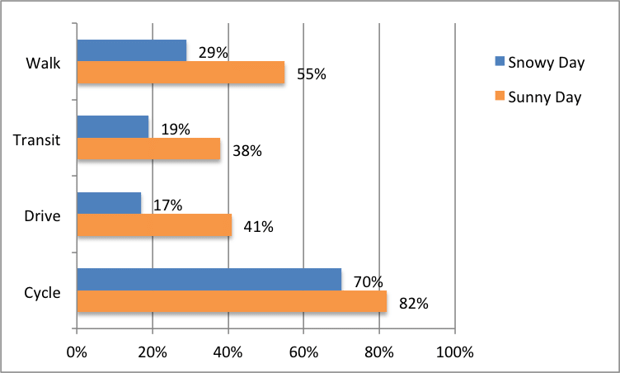
The researchers at McGill University in Montreal said when asked if they were energised after their cycling commute, 82 per cent of cyclists replied that they were.
Related News


And even on snowy says, 70 per cent of cyclists were energised after their morning ride.
Both of these reported energy levels were much high in cyclists than any other category of commuter surveyed.
For example, motorists felt energised just 17 per cent of the time on snowy days and 41 per cent of the time after commuting in the morning.
Those who took public transport felt energised on 38 per cent of sunny days and 19 per cent of snowy days after their morning commute. And those who did their morning commute by foot felt energised on 29 per cent of snowy days and 55 per cent of sunny days.
The research canvassed 5,599 people in 2013; all of whom worked or studied on the McGill University campus.
Does commute negatively affect your punctuality?
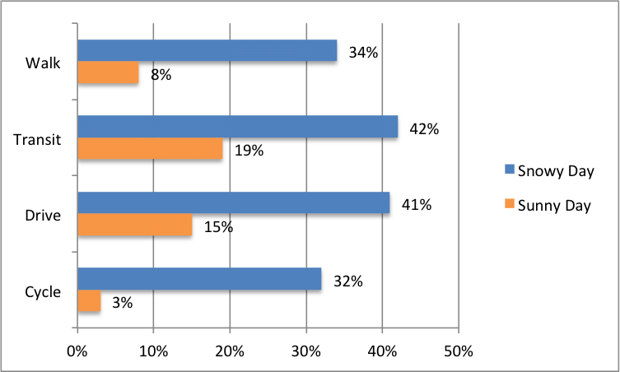
The researchers separated their findings into snowy and sunny days obviously because snow is a much more frequent occurrence in Canada than other parts of the world.
And they were also trying to determine of adverse weather impacted the well being of commuters across different modes of transport.
However, no such adverse finding emerged during the cyclists, with their feelings of being energised on even on snowy days much higher than other commuters on sunny days.
When it came to punctuality, the survey found 32 per cent of cyclists were delayed on snowy days compared to 34 per cent of walkers, 42 per cent of drivers and 42 per cent of those who too public transport.
When it was sunny only three per cent of cyclists said they were delayed by their morning commute compared to eight per cent of those who commuted by walking in the morning, 15 per cent of drivers and 19 per cent of those who took public transport.
Topics


