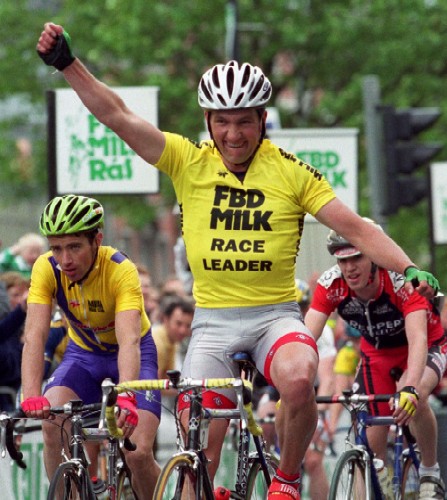
Rás Tailteann winner Philip Cassidy believes what type of Rás we have matters little, certainly in the short-term. The main thing is to hold a race called Rás Tailteann and get through these difficult times.
Rás Tailteann would currently be underway but for the 2019 edition being cancelled over lack of sponsorship; the recovering but still weak Irish economy doing Irish cycling no favours.
To mark the race's absence, stickybottle will publish a number of pieces through the week with members of the cycling community about the race.
In interviews and columns, well-known figures in Irish cycling will offer their views on Rás Tailteann's past, it's current problems and what the future may hold.
We kick off the series with an interview with double Rás winner Philip Cassidy.
Advertisement
Philip Cassidy talks Rás Tailteann
Having won Rás Tailteann twice there are few names in
Irish cycling more closely associated with the race than that of Philip
Cassidy.
He claimed his outright wins in 1983 and much later, on
the comeback trail, in 1999. Cassidy also picked up three stage wins along the
way during 19 appearances in the race.
The Meath man has also sponsored and managed Rás teams.
And his son Mark, a former An Post-Chainreaction rider, won a stage and held
the yellow jersey.
Given that his history is so steeped in the event and
that he has enjoyed commercial success on the business side of cycling – as a
store owner and brand distributor – his views on the difficulties the race now
faces will be carefully studied.
In the first instance, Cassidy is quick to mention the
record of former race director Dermot Dignam, and his family, who have run the
race for years.
When Dignam stepped down from the role of race director
Tony Campbell, also synonymous with keeping the race on the road, took on the
top job.
After five years at the helm Campbell ended his tenure and Eimear Dignam took on the job for the 2018 edition. She remains as race director.

“They’ve done so much for the race down the years,” Cassidy
told stickybottle of the Dignams and Campbell.
“In fact, you could nearly say this year they’ve fallen
on the sword of the success they built,” he added in reference to the race
being cancelled this year due to a lack of title sponsor.
Cassidy believed the conversation around the difficulties
the race was in has been muted in recent months precisely because it has been
run so well that few people thought it would falter.
The event was first held in 1953 and has run
uninterrupted every year since then; FDB Insurance having sponsored it for many
years before An Post took over as title sponsor in 2011.
However, An Post ended its backing in 2017 and the race
was only run last year on cash reserves, with some secondary sponsorships.
Unfortunately with the cash reserves spent last year and
no new title sponsor being secured, Eimear Dignam was forced to announce the
race would not go ahead this year. It would normally be taking place this week.
The plan now is to continue the search for a new backer
and get the event back on the road in 2020, retaining its UCI 2.2 ranking. In
the meantime, a four-day replacement event had been mooted for this year.
The cancellation of the 2019 edition sent shockwaves across Irish cycling. And Philip Cassidy believes future editions, at the very least the 2020 race, may need to be planned on the assumption no title sponsor will be found.
With a sum in the region of €350,000 required, he said
any deal involving that amount of money annually for several years may take a
long time to put together.
And so he believes it may be better now for the Irish cycling community to simply accept the current problems may not be resolved in the next 12 months; the Irish economy recovering but still weak.

Philip Cassidy also believed it was more important to run
the best Rás Tailteann possible than stick rigidly to the race’s current form
as a UCI 2.2-ranked race with all of the expenses that come along with that.
And if the UCI ranking was adding to the financial stress
on the race it should be abandoned, Cassidy said.
“The most important thing is the event itself and the
fact it’s an Irish race. It’s part of the heritage of sport in Ireland,” Cassidy
told stickybottle.
“It’s nice to have the UCI ranking but the race
continuing and continuing to be part of the sporting heritage of the country
has to be the key issue.
Related News


“I rode 19 editions of the race and won two overall and I
won three stages. But the only UCI points I ever got were in 2002,” he added of
riding Rás Tailteann and winning a stage just after it had secured its UCI 2.2
ranking in 2000.
“They were all hard; none of them were any easier or any
harder than each other. But everywhere were I go if I am at anything, the line
people use from time to time to introduce me is ‘double Rás winner’.
“A Rás winner is a Rás winner over the last 50, 60 years. If I’m ever in conversation, people would also compare my (wins) to, say, the Rás last year. They just see no difference.”

Whether his wins were UCI-ranked or not or exactly when
the race secured its ranking and the significance of the ranking, he said, were
issues never raised with him.
As a result, he believes the race should not get bogged
down on the ranking subject.
“For next year, if you assume there may be no sponsor
again, I’d forget the UCI ranking 100 per cent and run the best race you can
achieve,” he said.
“If you take Rás Mumhan; they’ve done a great job there
will minimal sponsorship. The Dignams have also been heading this up for years;
do they need more support?
“There’s a lot goodwill around the country, I think
people would stump up a bit of time and effort; maybe to call Eimear and offer
that help.”
Cassidy added whether the race had UCI ranking or not, it
would still attract foreign teams.
And irrespective of the ranking it would always be a very
hard event. He did not believe dropping the ranking, even over the short term,
would suddenly make the race easy.
And he also felt running the Rás without the ranking
didn’t need to result in it being less international.
“We always had teams over from the UK and places like
Belgium and France. In 1983 (his first Rás win –Ed) that was even the case back
then.
“It was a nice mix; an international field but not full
on pro or what we’d now call Continental level teams. And the stages weren’t
slow; believe me.
“Now the race has such a reputation around the world that
if there had been an eight-day race even this year and you sent out invitations
to Belgium or Holland and the UK and wherever else; and you told people when
and where the race was on, that they were invited and what their entry fees
was; I’d love to see how many of them would have taken up the invite and come.
“I’d love to see who would come if teams had to pay their
own expenses rather than (the race organisers) digging into their own coffers
and paying expenses for the Continental teams.
“The race is unique and has a superb reputation and I
believe there would be quite a take-up on that; especially from the UK.
“You may not get those Continental teams coming but there
are a huge amount of elite amateur squads around Europe looking to develop
their riders. And I believe they’d come.
“It’s hard to find this type of race that those teams
could come to and develop their riders,” he said.
Cassidy also felt it was beyond any doubt that both
national selections and teams just below Continental level would still want to
ride the Rás if the UCI ranking was gone.
“I guarantee you the stages won’t be any slower with
those types of teams,” he stated, stressing no expenses whatever would be paid
under his idea of how the race might be run.
“If there’s no budget, or not the kind of budget there
was before; then that’s just the way it is. And if we get 130 Irish guys racing
around the country for eight days; great.
“If there were 30 or 40 British riders also in there,
they always provide great competition and they’d love it too.
“When the race is more based around the domestic riders,
with some international teams in there, it allows the domestic riders to shine
a bit more.
“Some of the riders who might have a perception they are
not of a certain standard (associated with a UCI-ranked race) would come to the
fore.
“I think sometimes some of the domestic riders; when they
see the pros with the tanned legs and so on, they may not really want to go
past them.
“But if there’s a load of Paddies in the race and on the
front; they might say to themselves more ‘I’m getting up there and I’m having a
go’. They Irish guys would just grow in confidence.
“At the same time the average speeds won’t drop. But it
just might give guys the tools to actually race; give them the confidence.
“For continuity, until another sponsor is found, it
really doesn’t matter hugely who rides the race as long as you have a race and
a race winner. But have a race.”
Topics


