
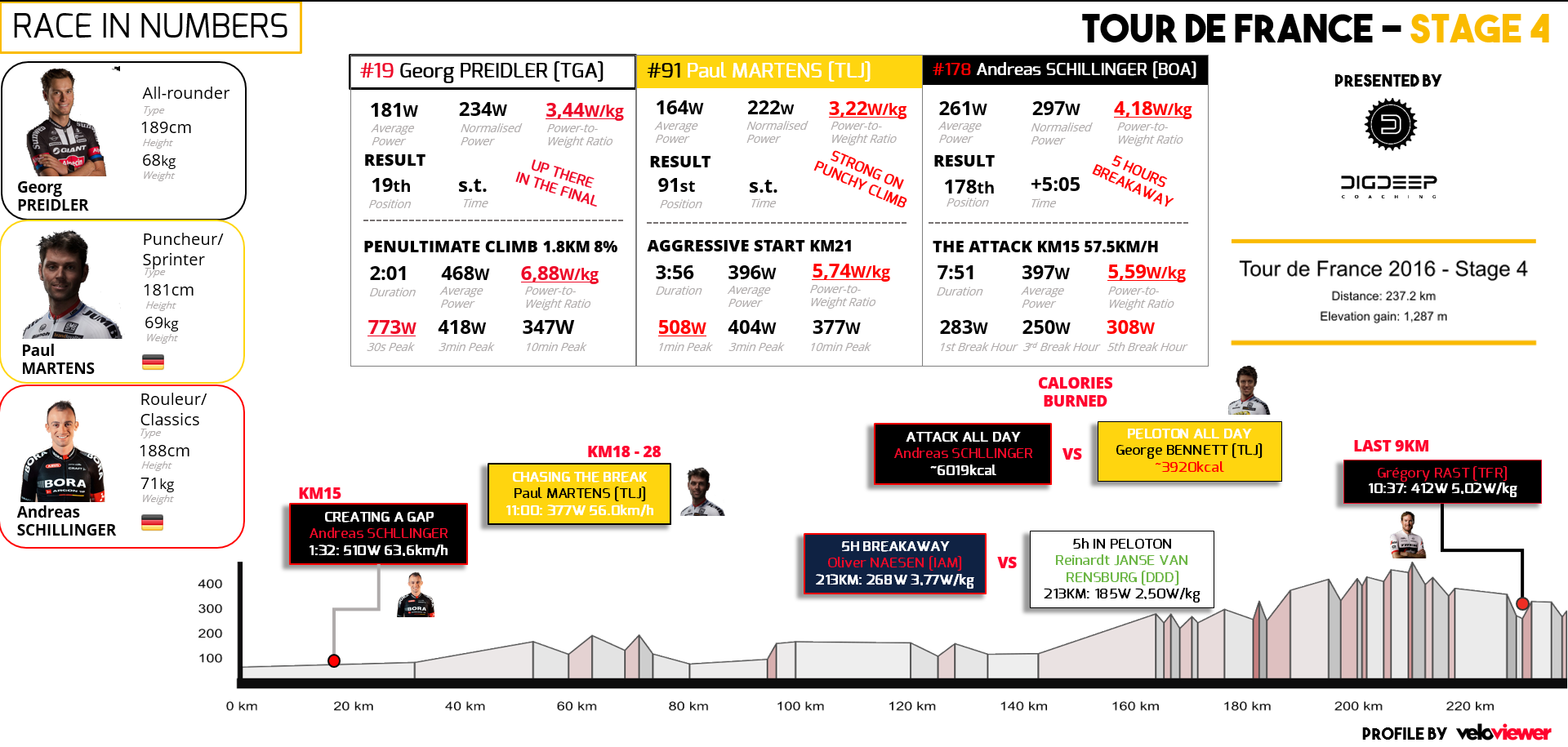
The data shows just how much harder than the peloton this escape had to work to stay ahead for as long as it did. They produced far more Watts and burned considerably more energy.
Stephen Gallagher and Philipp Diegner of Dig Deep Coaching have teamed up with @VeloViewer on a fascinating data project for the Tour de France
They bring us this easy to follow top notch analysis of the data from some of the stand-out riders during yesterday’s 237km stage 4 from Saumur to Limoges
A lot of the information is contained in two images below and you’ll need to click on them to make them full size and easier to read.
Easy long day with a tough finish
Stage 4 to Limoges, the longest stage in 2016, saw the peloton content to allow a 4-man early breakaway to go clear.
Advertisement
They rode away with a good lead that only got reduced once the sprinter’s teams really picked up speed after about 200km of racing.
The final in the city of Limoges proved dramatic once again, as Marcel Kittel (Etixx-Quickstep) beat Bryan Coquard (Direct Energie) and Peter Sagan (Tinkoff) to the line on a surprising steep finish.
Races accelerates going into the final
The stage offers ideal comparison between the sustained efforts riders in a breakaway have to put in to stay ahead of a larger group where the workload can be shared between many riders.
Oliver Naesen (IAM Cycling) rode for 5 hours in the break with 268W average power, while Mark Cavendish’s teammate Reinardt Janse van Rensburg (Dimension Data) had to put out 185W, or 2,50W/kg, while fulfilling his duties for the British green jersey holder.
Andreas Schillinger, who was in the breakaway as well, had an impressive Normalised Power of 297W (4,18W/kg) over the whole stage, covering 237km in 5:30 hours.
The difference in intensity leads to significantly varying energy expenditures, as Andreas Schillinger burned more than 6000kcal versus about 3900kcal of George Bennett (LottoNL – Jumbo) in the peloton behind.
By way of an everyday real-life example; 6,000kcal equals at least six large pizzas!
Breakaway works much harder than peloton
Click on image for a larger, easier to read, version
Related News


It was all about the final 500M
Inside the last 10km the stage displayed the typical characteristics of a Tour stage again.
Almost all teams want to take something out of the final and the fights for position cause the hardest kind of competition.
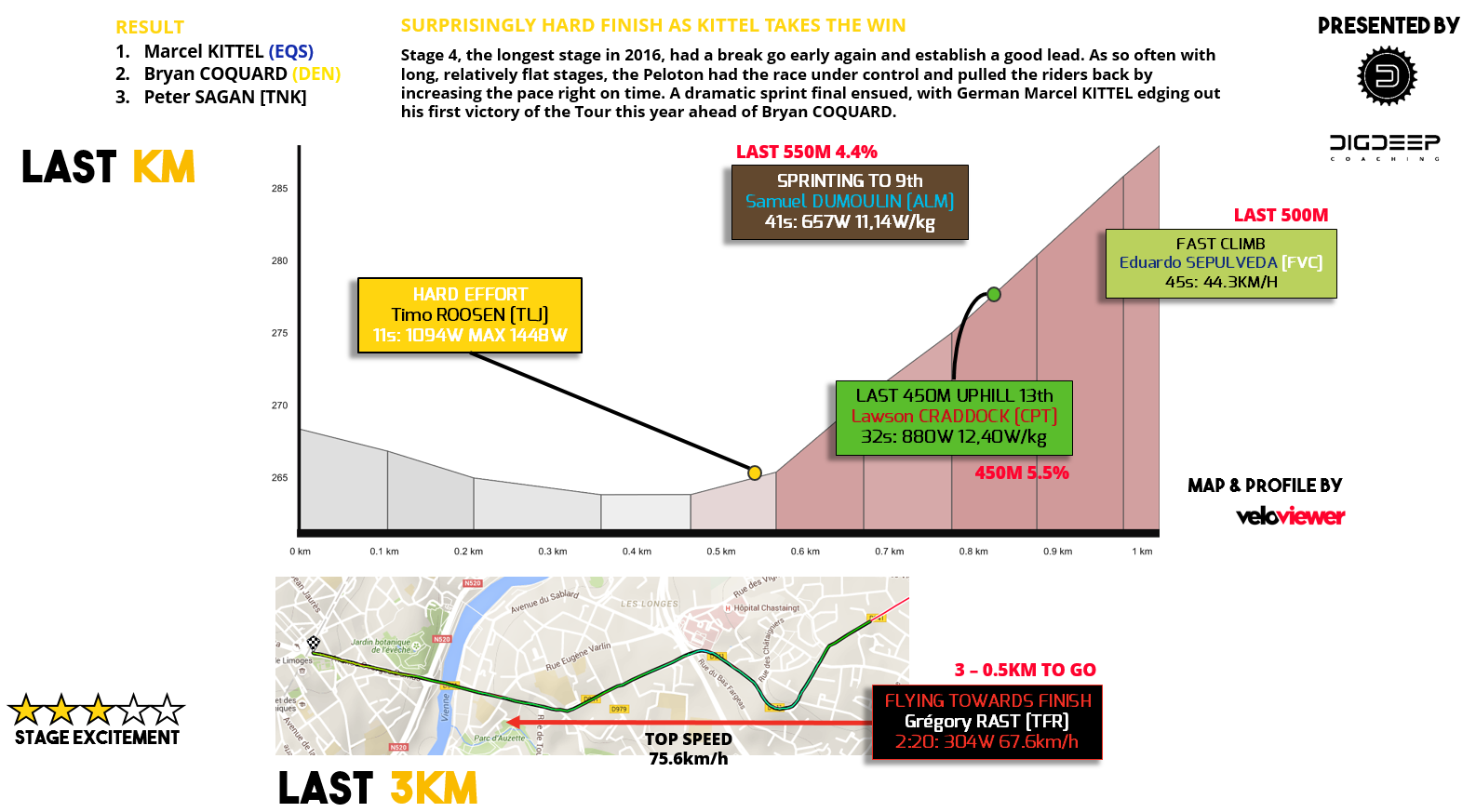
Trek’s Grégory Rast put out more than 410W in that period to stay at the front as everyone prepared for the last 500 metres, where the race would be decided on a 5.5 per cent incline.
The climb saw the riders reach incredible speeds on an ascent. Even 54th placed Eduardo Sépulveda flew up the incline at nearly 45kmh, taking the momentum from a furious approach.
The top performers showed their world-class once again.
Samuel Dumoulin’s 657W or 11,14W/kg for 41secs were enough for a 9th place and GC hopeful Lawson Craddock contested with 880W (12,40W/kg) inside the last 30s to finish a respectable 13th.
The final of stage 4 in numbers
Click on image for a larger, easier to read, version
The climbing begins
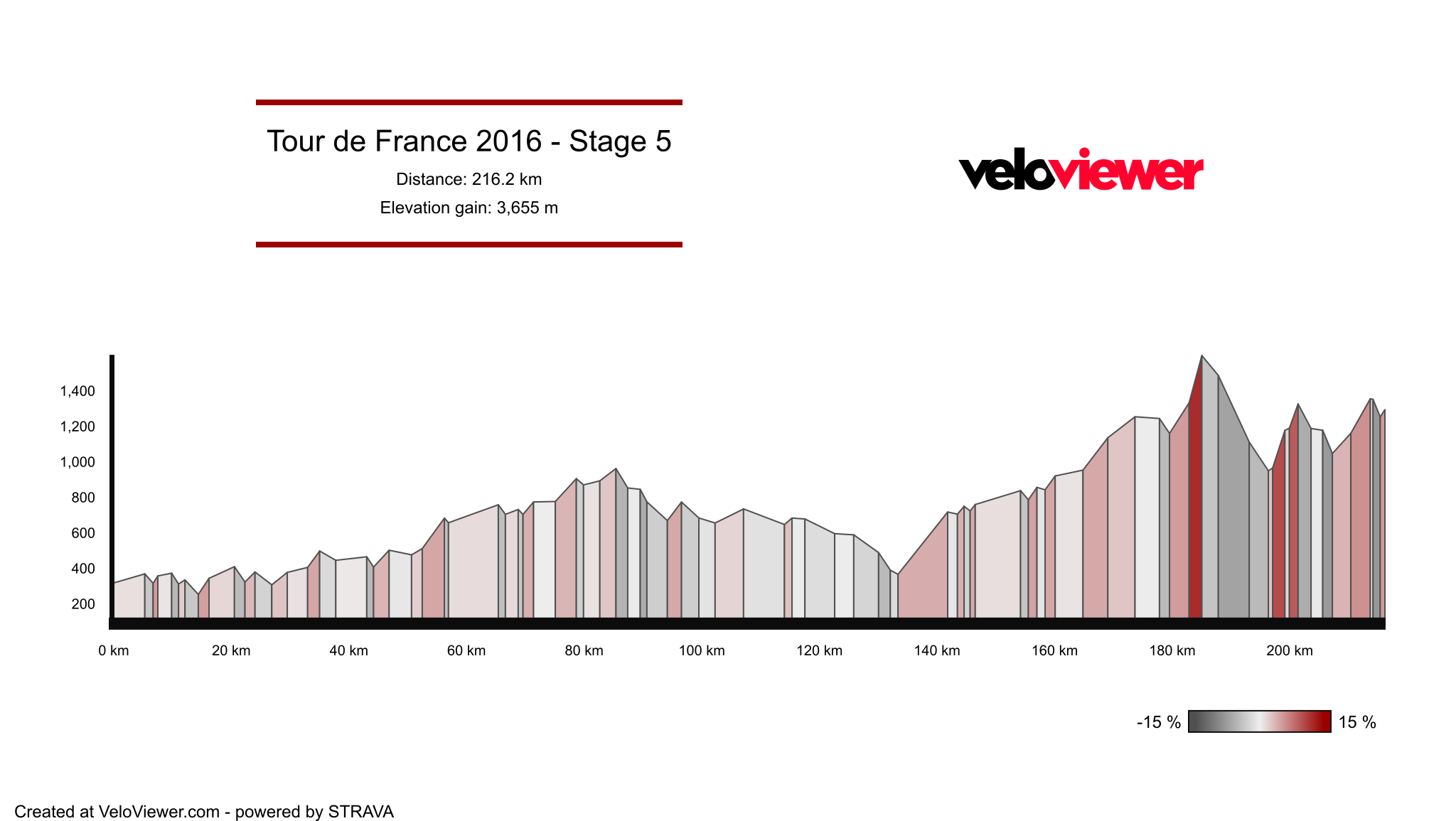
Stage 5 today – Wednesday - is going to change the shape of the race, favouring riders that enjoy “punchy” climbs and want to take their chance before the race into the high mountains.
Riders like Julian Alaphilippe and Dan Martin from Etixx-QuickStep or Alejandro Valverde (Movistar) are going to be in the spotlight when they head towards Le Lioran in the picaresque Monts du Cantal.
But the hopefuls for a good overall position at the end of the race cannot allow themselves a weak performance either, as the three steep climbs may cause time difference that could rule out some riders from the competition.
Profile to stage 5 today, Wednesday
Click on image for a larger, easier to read, version
Topics


