
Tom Dumoulin on his way to winning the Tour TT, but further back the field riders with a better power to weight ratio and who produced more power were slower than those who were not as strong but were more aero.
Stephen Gallagher and Philipp Diegner of Dig Deep Coaching have teamed up with @VeloViewer on a fascinating data project for the Tour de France
They bring us this easy to follow top notch analysis of the data from some of the stand-out riders during Thursday's stage 11 on the Ventoux and the stage 12 TT on yesterday, Friday.
A lot of the information is contained in three images below and you’ll need to click on them to make them full size and easier to read.
Ventoux: Savage and chaotic
The stage 12 finish on the Mont Ventoux Tour de France delivered the spectacle it had promised. Some of it was for the wrong reasons, however.
Advertisement
When the riders started to tackle the steep road climbing the Giant of the Provence to the new finish at Chalet Reynard, they had already covered 165km in a fashion that would have been rated intense at the very least.
Once again, the field was troubled with strong winds during the race. The ensuing chaos on the Ventoux caused by too many spectators on too short a road was the cherry on the cake for the fans at home, after a great battle on the climb before.
The key numbers from stage 12
Click on image for a larger, easier to read, version
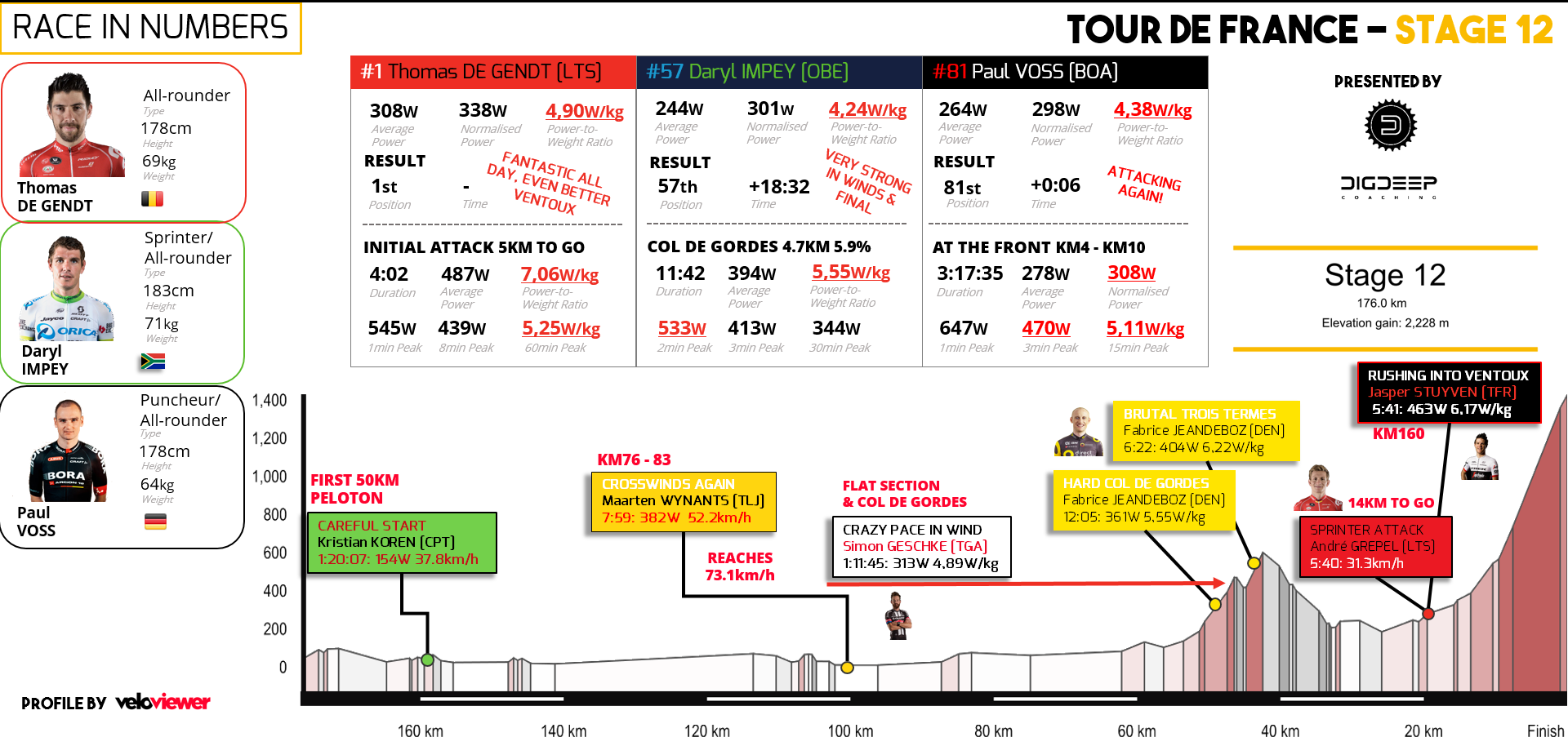
The stage victory was taken by the incredible Thomas de Gendt (Lotto – Soudal). He finally reaped the rewards for his tireless attacking.
Behind Mollema, Porte and Froome appeared to be the strongest of the GC guys, while Quintana showed some weakness.
In the peloton and later struggling alone, Daryl Impey (Orica–BikeExchange) rode the whole stage at 244W average, 301W normalised (NP), equating to 4.28W/kg.
However, the numbers are slightly understating the intensity of the stage, as the first 45min were ridden quite easy, after the break had gone (172W). The last 100km was done in 292W and even 331W NP (4,65W/kg).
The middle of the stage really made it tough for the Peloton as they entered a section with strong gusts. From 80km onwards, Simon Geschke (Giant–Alpecin) rode for about 75min at 4.9W/kg average, at nearly 50km/h average speed.
The field then climbed to the Trois Termes over the Col des Gordes, where Fabrice Jeandeboz (Direct–Energie) had to put out 361W (5,55W/kg) for 12 minutes and 404W (6,22W/kg) for 6:22 minutes, respectively; all that before the Ventoux had even come into sight.
The final approach saw classics specialist Jasper Stuyven (Trek–Segafredo) invest 463W (6,17W/kg) for nearly 6minutes to set up captain Bauke Mollema.
How Ventoux (Charlet Reynard) broke down
Click on image for a larger, easier to read, version
Ventoux stage-winning numbers
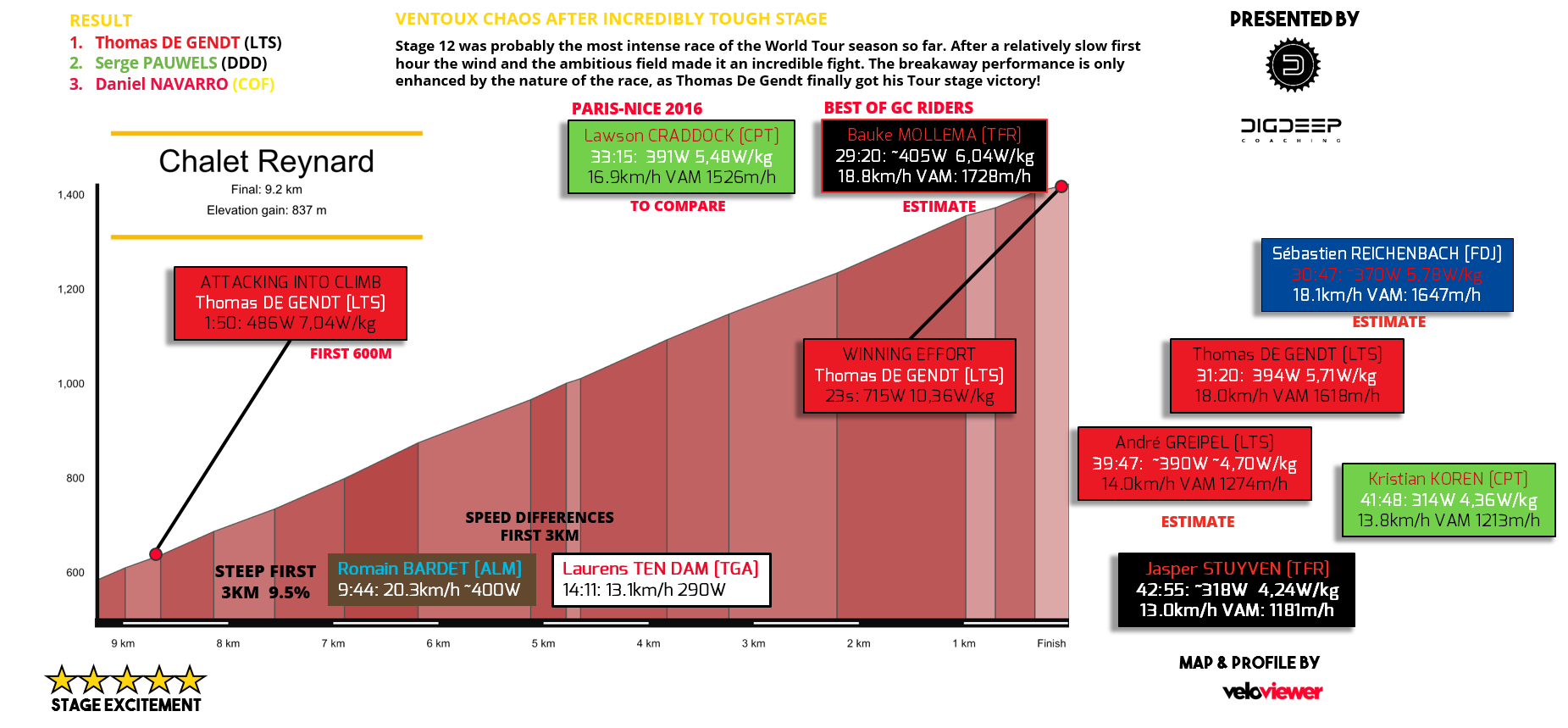
Stage winner de Gendt spent the whole day on the attack. His average power was 308W with 338W NP (4,90W/kg).
That alone would have been impressive enough but the way he was still able to perform on the 9.2km, 8.5% final climb to Chalet Reynard shows the full extent of his strength.
He rode it in 31:20 minutes with a power output of 5.71W/kg (394W).
His final dig for the line, to take the win ahead of Serge Pauwels (Dimension Data), saw him put out 715W for 25 seconds!
De Gendt lost just 2 minutes on the whole climb to the best climbers from the peloton.
Related News


The best time was clocked by Bauke Mollema, who dropped everyone but Froome and Porte.
His 29:20 minutes required approximately 405W (6.04W/kg), an uphill speed of 18.8km/h.
Looking at the speed differences illustrates how the climb separated the field.
Romain Bardet at the front flew along the first 3km in 20.3km/h while Laurens Ten Dam, not a bad climber himself, lost 4:30 minutes while riding with 13.1km/h.
Saturday’s sage 13 - Wind still a factor in TT
The first time trial of the 2016 Tour de France was always going to be a pivotal point in the fight for the GC and stage 13 lived up to those expectations.
The main factors of yesterday’s stage were the hilly terrain which the riders tackled along with the windy conditions that changed during the day.
The wind had a big influence on the final placings of the stage with many riders being hampered by the constantly changing conditions.
It can easily be seen by some of the riders’ power to weight ratios which were significantly different, even between riders who didn’t start far apart.
The key numbers from stage 13 TT
Click on image for a larger, easier to read, version
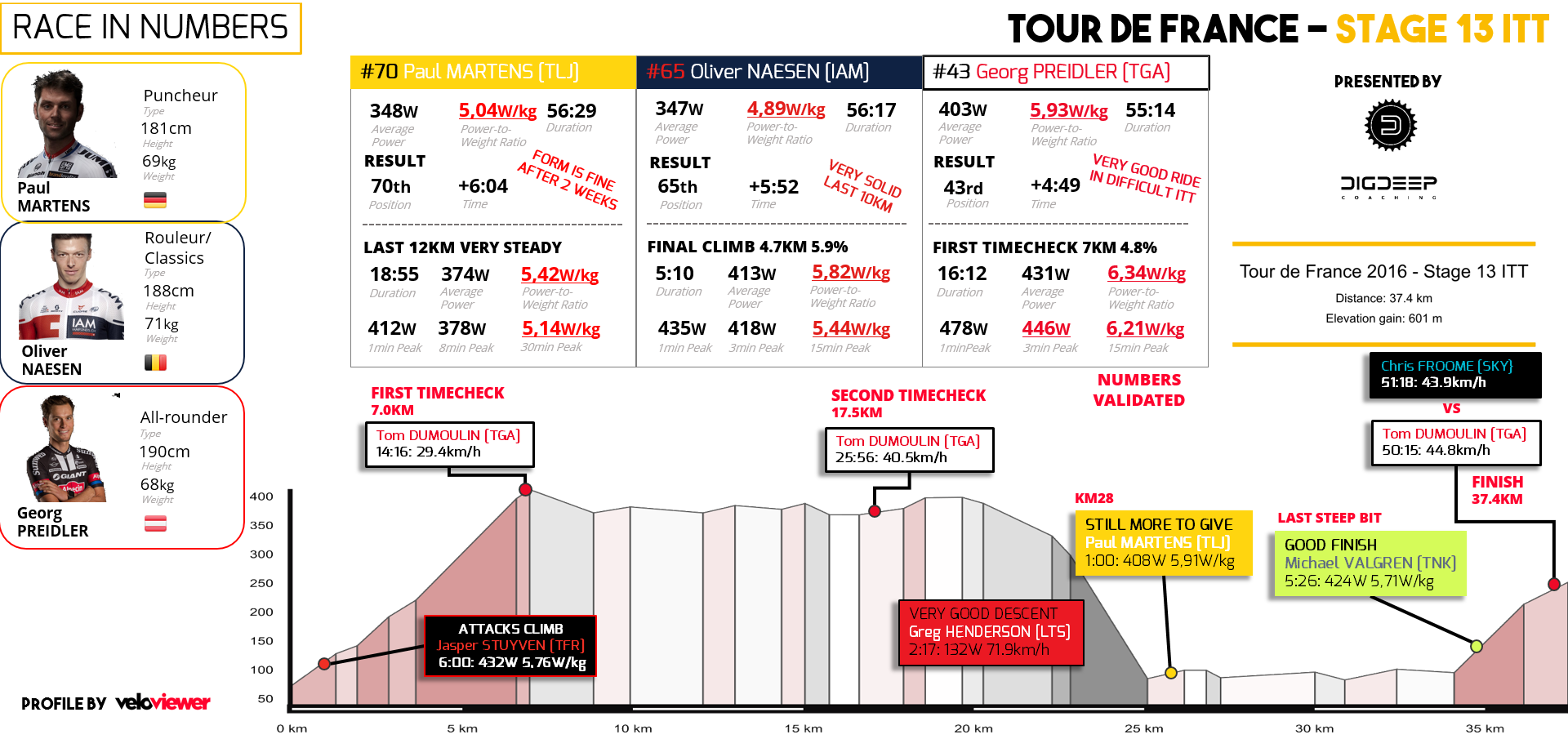
The start of the stage saw the riders tackle a 6.9km climb that took stage winner Tom Dumoulin (Giant–Alpecin) 14:02 minutes to race up.
His estimated power output was 430W (6.06W/kg) at 29.5km/h; an incredible performance.
But from the power files we have analysed you can see riders with a higher power to weight ratio rode significantly slower.
That may be due to wind and also due to a less aerodynamically efficient position and/or kit.
An example of this is Thomas De Gendt (Lotto–Soudal) riding this section at 6.16W/kg in 15:22 and most significantly Dumoulin’s teammate Georg Preidler riding at 6.31W/kg but covering this distance slower, in 15:59.
Even though Preidler rode at 0.15W/kg higher than De Gendt he covered the distance 37sec slower and lost nearly 2 minutes to Dumoulin.
This would mostly be down to the wind conditions which met each of these riders and some aerodynamic factors.
Even strong climber Quintana lost nearly 1 minute on just the first climb on stage winner Dumoulin and 33 seconds to Froome, who rode it at about 6.14W/kg and 29km/h.
Stage 13 TT final climb
Click on image for a larger, easier to read, version
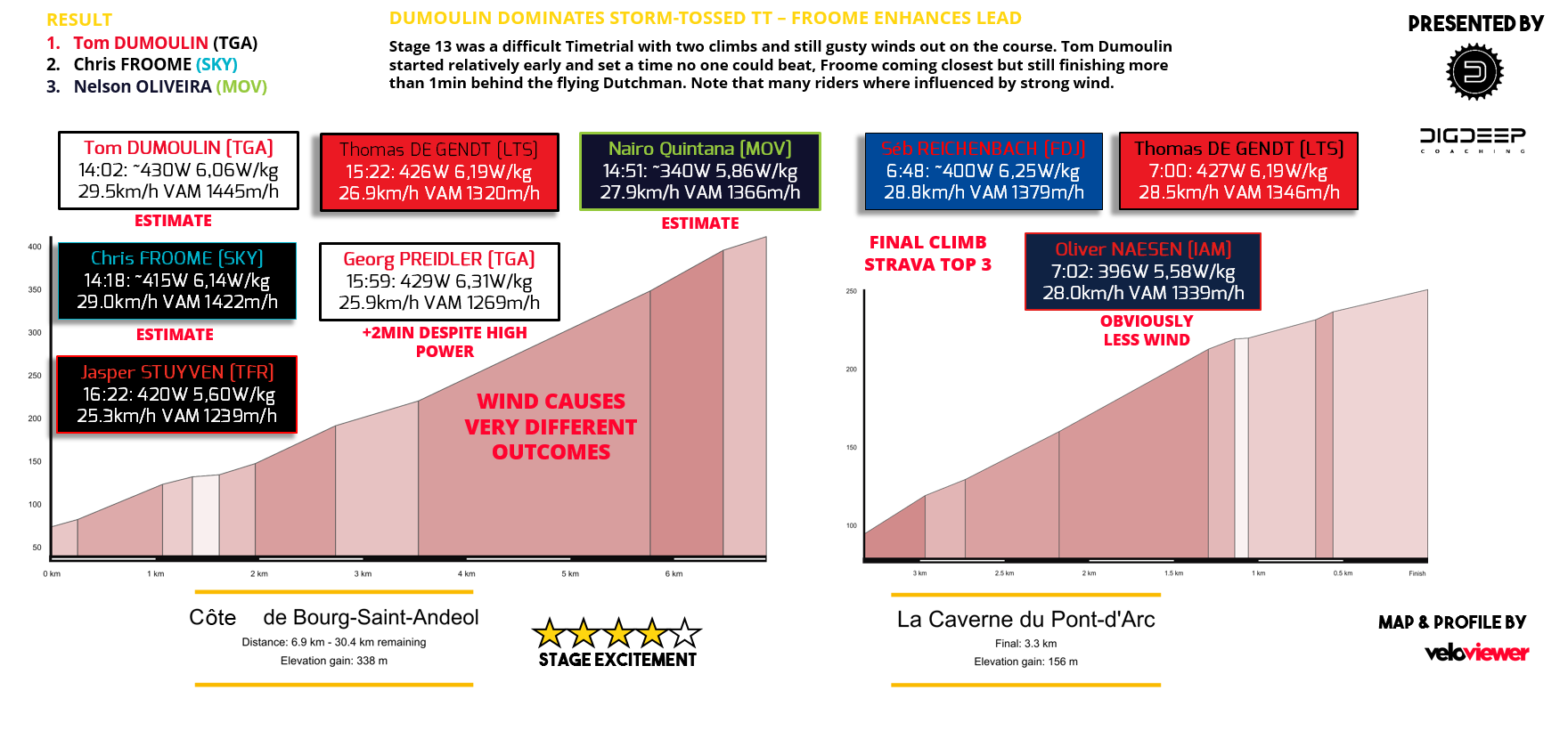
The dangerous conditions which met the riders on the stage had a major influence on the final result for many riders.
But it is also easy to see those who paced their effort as evenly as possible also finished with a better time compared to those who went too deep on the early climb and failed to recover for the rest of the stage.
The last 3.5km of the TT climbed again; Oliver Naesen (IAM) having judged his effort especially well.
He still put out 396W (5.58W/kg) for 7:02. The wind was still a factor though, as on-form De Gendt had to put out 6.19W/kg or 427W for a time just 2 seconds faster.
With the leading riders having to accomplish around 6.1-6.2 w/kg for 50min+ to finish in the top 10, we are in to see large battles in the Alps between the GC contenders.
Topics


