
The analysis of the speeds yesterday - especially in the final as the peloton hurtled towards the bunch finish - at the Tour de France throws up some interesting facts. Marco Haller, for example, not only went faster in the sprint than his Katusha sprinter Kristoff but was his top speed was higher than winner Cavendish.
Stephen Gallagher and Philipp Diegner of Dig Deep Coaching have teamed up with @VeloViewer on a fascinating data project for the Tour de France
They bring us this easy to follow top notch analysis of the data from some of the stand-out riders during yesterday's stage 14.
A lot of the information is contained in three images below and you’ll need to click on them to make them full size and easier to read.
Advertisement
Saturday's stage 14 of the Tour de France from Montélimar to Villars-les-DombesParc des Oiseaux was a classic transitional day.
No real difficulties waited for the riders and the sprinters’ teams finally hoped for their chance again.
The peloton controlled a four-man break all day, while investing the least energy possible.
The wind was still a small factor in the final. The fact that Mark Cavendish won was no surprise. It was his fourth victory this year and the 30th Tour stage of his career.
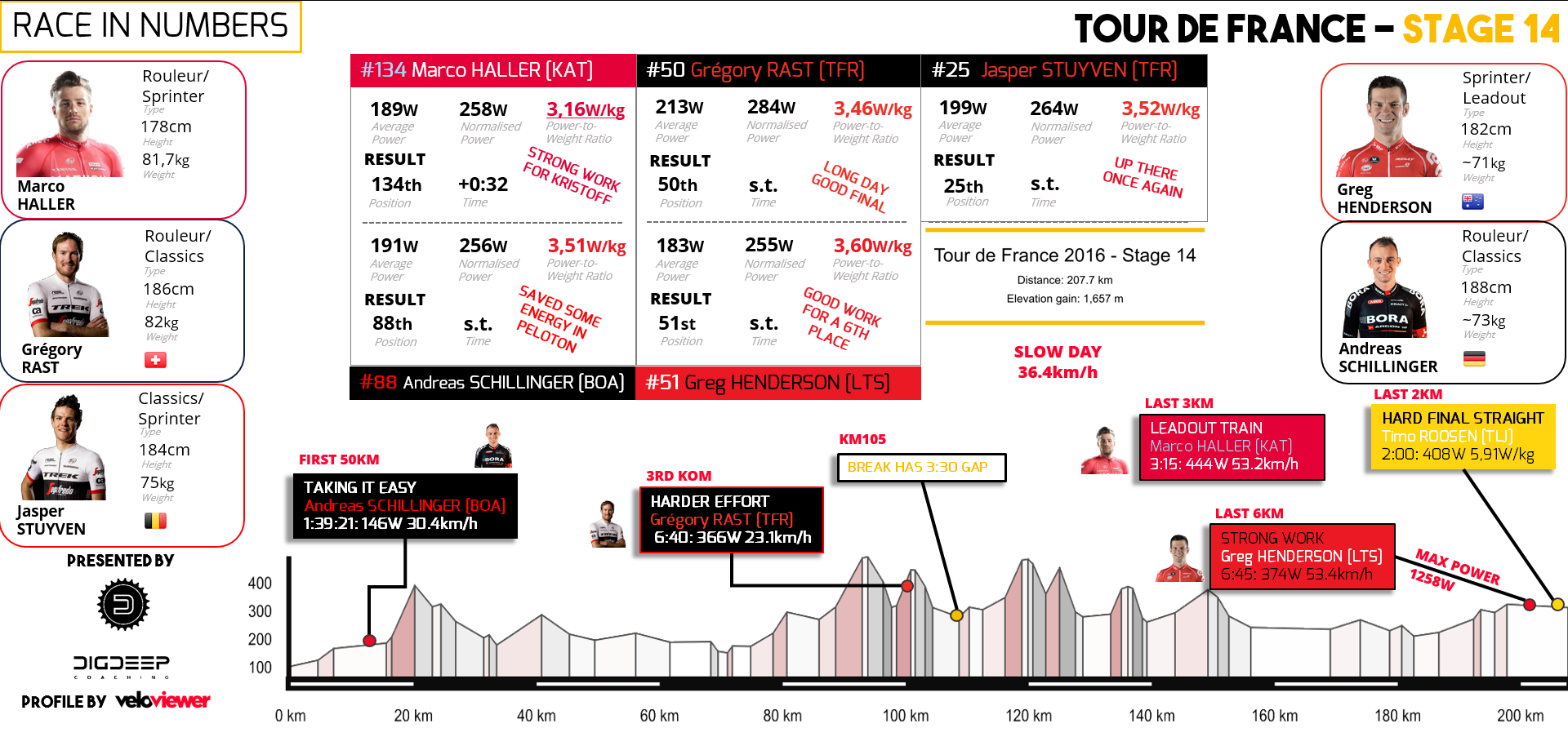
Saturday's stage 14; the main numbers
Click on image for a larger, easier to read, version
Marco Haller: Smashing it for Kristoff in final
Looking at Austrian strongman Marco Haller’s (Katusha) performance shows how the stage developed.
Haller rode in the main field all day and like almost every rider, his average power did not reach 200W.
He covered just 29.8km/h in the first hour in 141W (1.72W/kg). By the third hour, the group had started to chase the break half-heartedly and power and speed increased to 198W and 35km/h.
It was only in the last 20km, however, that the race really begun. Haller is a main component of Alexander Kristoff’s leadout train and had to work hard for his captain.
His speed accelerated to about 45km/h and he put out 337W for 27:13min. In his role delivering the Norwegian sprinter into a perfect position for the final, Haller’s strongest effort came from 4km to 500m to go.
Related News


He rode very hard at the front of the field with 463W for 3:35min; at 54.3km/h by this point.
He even reached more than 70km per hour top speed; more than Cav in his final dash to the line for stage victory.
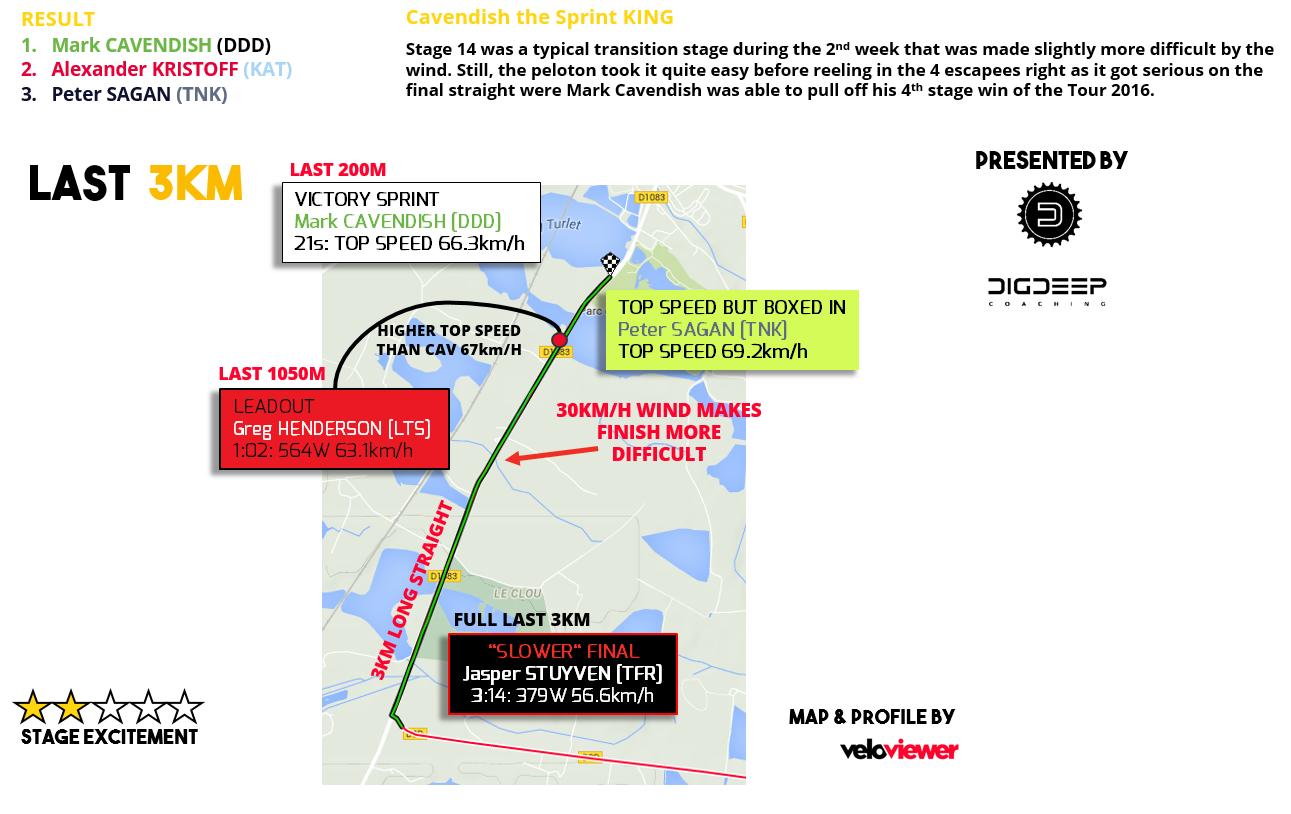
His captain took 2nd place in a good sprint behind the Manxman, while Peter Sagan was 3rd, even though he reached the best sprint pace with 69.3km/h.
Last 3km, Saturday's stage 14
Click on image for a larger, easier to read, version
Comparing stage 14 to first week speeds
In comparison to the way the motivated peloton rode the flat stages in the first week, stage 14 was a really slow one.
The average speed yesterday was a mere 36.4km/h. On stage 1 a much more furious pace had been present and resulted in 44.4km/h for the whole day.
Of course, the wind played a small role yesterday, but the work the riders had to perform was significantly lower as well.
Overall, the field was very conscious of the days to come, as the Alps loom large.
No one is willing to invest as much before the Tour begins one of the toughest last weeks in a long time.
Looking ahead to Sunday's stage 15
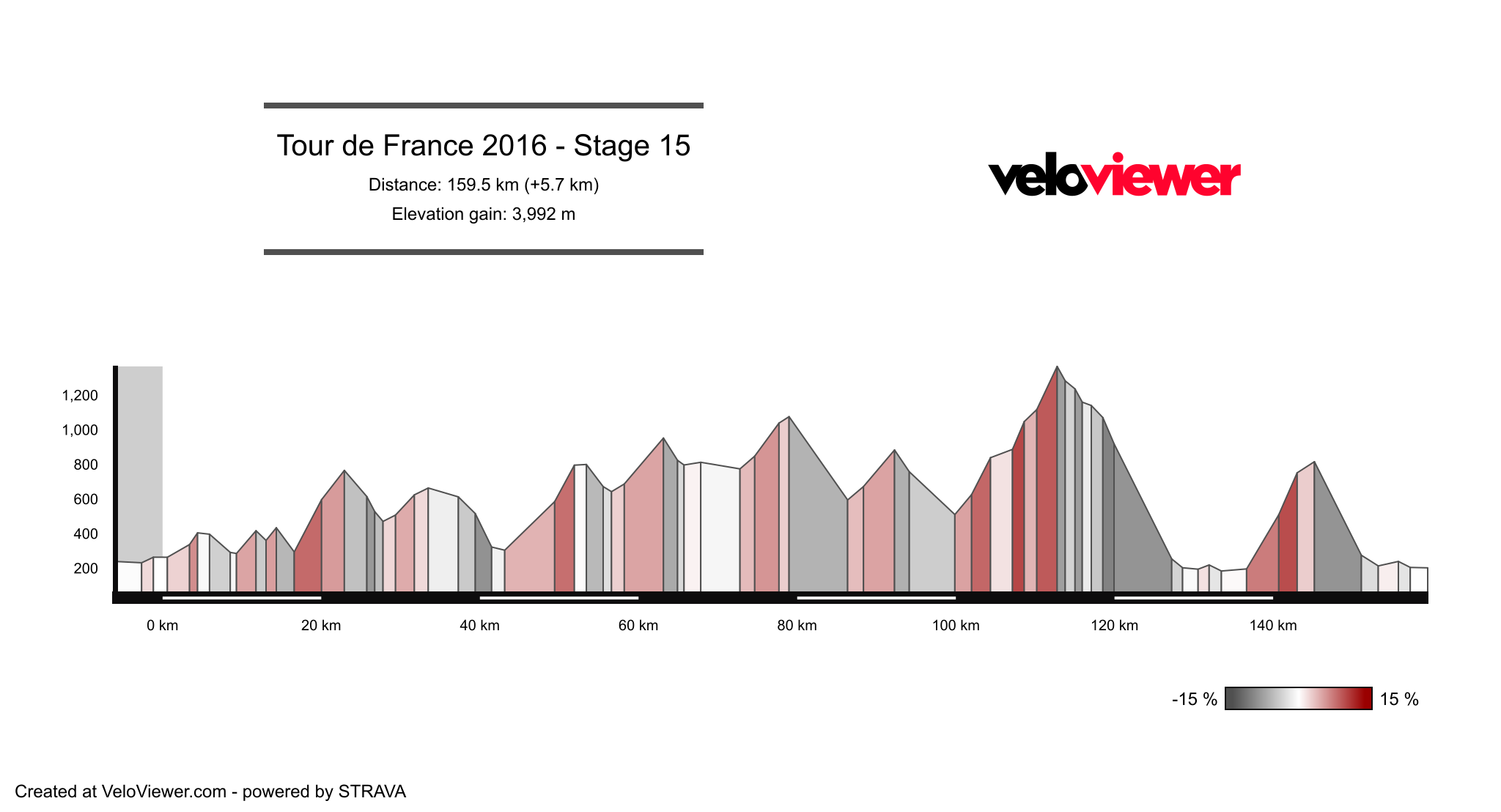
Stage 15 today, Sunday, will take the Tour from Bourg-en-Bresse to Culoz.
There are a number of tough shorter climbs before a particularly steep last ascent to Lacets de Grand Colombier (8.4km; 7.6%) and fast downhill to the finish.
The stage is relatively short as well so we are in for some aggressive racing.
Sunday's stage 15 profile
Click on image for a larger, easier to read, version
Topics


