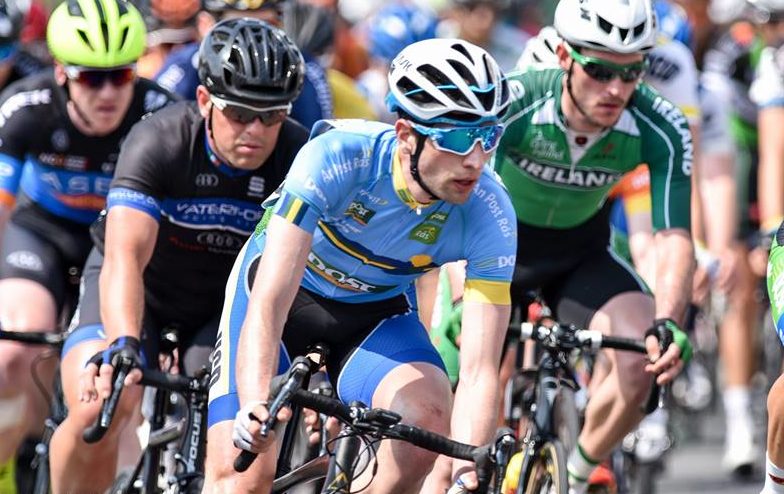
Ian Richardson knows all about the pain of Rás Tailteann and climbing onto the race's podium. He says the event's UCI ranking is crucial so that Irish amateurs have something to aim for.
Since Stephen Gallagher won Rás Tailteann back in 2008, only one Irish cyclist who spent his whole career in the amateur ranks has finished in the final top 10 overall; Ian Richardson.
As well as several county rider awards on Rás Tailteann stages, he was also 10th overall in the event in 2015.
Yesterday, Philip Cassidy told stickybottle it was imperative a race called 'Rás Tailteann' continued to be run each year for the sake of continuity and the race's survival, you can read that piece by following this link.
In this column by Ian Richardson, he says the race's UCI ranking is crucial; giving the Irish amateurs a unique challenge and sense of achievement if they make it all the way.
Advertisement
Ian Richardson on the uniqueness of the Rás
For many in the Irish cycling community,
news that Rás Tailteann had not secured a sponsor for 2019 and would therefore
not be run this week was a bitter blow.
I’ve had plenty of time to reflect on my
memories of the Rás. I have been witness to the race from many perspectives,
from the broom wagon to the break-away and podium, from the back of an
ambulance, and as a manager and spectator.
I’ve witnessed how unique the Rás is
compared to so many other races of its rank, and how important it is to Irish
cycling history.
It remains to be seen how the loss of
such a great race will impact the quality of the sport in years to come.
Dan Martin recently stated that the Rás should go back to its roots as an Irish amateur race, believing it’s lost its character in some way. I would wholeheartedly disagree.
The character of the Rás is defined by the battle between the county rider and the professionals; a real-life Iliad, an epic of mortals Vs titans.

In no other sporting event can a
postman, carpenter, engineer or statistician rub shoulders (often literally)
with the future world champions of our sport and prevail.
As a county rider, being known as a ‘Man
of the Rás’ signifies a certain sense of pride; that which comes from knowing they
have battled the Gods (and in rare cases, defeated them) and lived to tell the
tale.
The UCI rank of the Rás has also pushed
every Irish rider willing to participate to train harder than they would
otherwise, or to see the Rás as an opportunity to demonstrate their strength
among an international field.
Related News


I fear that without the incentive or
opportunity of a UCI ranked Rás that the quality of Irish riders would diminish
and many of our younger riders will decide to race abroad before they are
ready, having not experienced what it takes to race at continental level.
The Rás is unfortunately an early casualty
of the unviable sponsor-driven economic model of cycling, exacerbated somewhat
by the looming threat of Brexit.
No other sport has such a strange funding
system as cycling, with teams appearing to vanish or change hands from year to
year at the whim of a philanthropist’s ego.
The only constant source of revenue for
teams comes from the endemic sponsors who must spread themselves across
multiple teams.
The departure of Sky as the biggest team
sponsor undoubtedly sent shockwaves through financiers, signalling that cycling
is not somewhere you want to put a marketing budget if you want a good return
on investment.
That ship has been steadied somewhat
with Ineos coming in, though it is a controversial sponsor.
Prior to the formation of the Continental
level team, national teams filled this space and national federations funded
these teams.
Those teams were linked to relatively
stable government funding, compared to the volatility of the sponsors at Continental
level.
During this time the Rás and many races
like it formed a vital part of the European race calendar for national teams.
And these teams were able to foot some
of the travel and accommodation bills that UCI-ranked races are expected to
cover for continental teams.
All these factors have conspired to
leave races like the Rás in a bind. With a budget of €350,000, the Rás has to
pay expenses for the Continental teams to compete.
Who is willing to foot such a bill when
investing that money in a county football team will surely give a greater
return in exposure than the 30 seconds of coverage on the
Six One News?
FBD and An Post both had cycling
enthusiasts at the helm, both of whom knew the importance of the Rás in the
Irish zeitgeist.
But with race expenses increasing, major
companies leaving the sport and companies increasingly scrutinising their
marketing budgets, a change from the UCI and government funding may be needed
for races like the Rás to be maintained in the long term.
That all being said, I am confident that
the Rás will return as a UCI-ranked race. I am confident that the Dignam family
and the rest of the Rás organisers, who maintained the race since 1953, will
secure a sponsor for the future.
And I am confident that the David and
Goliath battles staged on the bóthairíns of Ireland will return.
Topics


